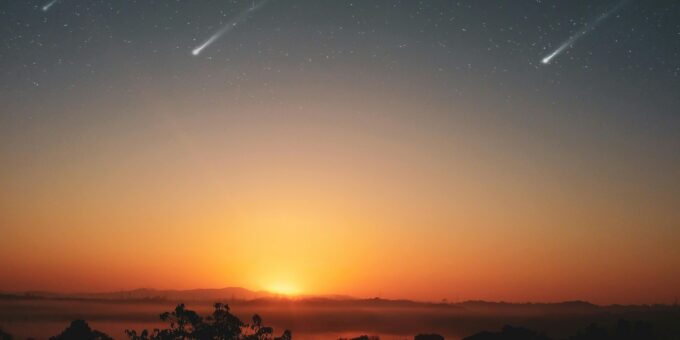
There is nothing more exciting than seeing a bright streak flash across the night sky. If you have ever wished to predict and witness these celestial events, learning How to Track Meteor Showers and Shooting Stars is easier than you might think.
Meteor showers occur several times a year. With proper planning and the right tools, you can dramatically increase your chances of seeing dozens of meteors in a single night. In this complete guide, you will discover proven strategies, tracking tools, and expert tips to master How to Track Meteor Showers and Shooting Stars like a seasoned skywatcher.
What Are Meteor Showers?
Meteor showers happen when Earth passes through debris left behind by comets or asteroids. As these tiny particles enter our atmosphere, they burn up and create bright streaks of light.
These streaks are commonly called shooting stars. However, they are not stars at all. They are small pieces of cosmic dust traveling at high speeds.
NASA provides detailed explanations of meteor science through its
meteor and meteorite educational resources, which can deepen your understanding.
Why Learning How to Track Meteor Showers and Shooting Stars Matters
Meteor showers are predictable. Unlike random astronomical events, they follow annual cycles. When you understand How to Track Meteor Showers and Shooting Stars, you can plan ahead and never miss a major display.
Tracking also improves your astrophotography, event planning, and even educational content creation. Many astronomy bloggers turn meteor tracking guides into passive income streams through affiliate marketing and educational resources within an online business.
Know the Major Annual Meteor Showers
Several meteor showers occur every year. The most popular include:
- Quadrantids – January
- Lyrids – April
- Perseids – August
- Orionids – October
- Leonids – November
- Geminids – December
For accurate annual peak dates, consult the
International Meteor Organization meteor calendar. It provides reliable forecasting information.
Understand Radiant Points
Each meteor shower appears to originate from a specific point in the sky, called the radiant. For example, the Perseids radiate from the constellation Perseus.
Knowing the radiant helps you determine where to look. However, meteors can appear anywhere in the sky. You do not need to stare directly at the radiant.
Use Technology to Track Meteor Showers
Sky Mapping Tools
Apps like
interactive sky map tools allow you to locate constellations and radiant points easily.
Weather and Cloud Tracking
Clear skies are essential. Use reliable weather forecasting tools before planning your observation night.
Moon Phase Planning
Bright moonlight reduces visibility. Check moon phases via
moon phase calendars to schedule around darker nights.
Best Time to Watch Meteor Showers
The best time to observe meteors is usually between midnight and dawn. During these hours, your location on Earth faces the direction of travel, increasing meteor frequency.
Peak activity often lasts only a few hours. Therefore, timing is crucial when learning How to Track Meteor Showers and Shooting Stars.
Choose the Right Location
Light pollution significantly reduces meteor visibility. Travel to darker areas whenever possible.
The
International Dark Sky Places directory lists certified dark-sky parks ideal for meteor watching.
If you must stay home, position yourself away from streetlights. Allow your eyes 20–30 minutes to adjust to darkness.
What Equipment Do You Need?
The beauty of meteor watching is that you do not need a telescope. In fact, telescopes limit your field of view.
Recommended items include:
- Reclining chair or blanket
- Warm clothing
- Red flashlight
- Thermos with a hot drink
For photography, you will need:
- DSLR or mirrorless camera
- Wide-angle lens
- Tripod
Many content creators review photography gear and monetize those reviews through affiliate marketing. Compared to operating a dropshipping business for camera equipment, affiliate partnerships simplify logistics. When evaluating affiliate vs dropshipping, affiliate programs often require lower overhead and support scalable passive income.
How to Photograph Shooting Stars
Capturing meteors requires preparation.
Use Manual Mode
Set your camera to manual settings.
Wide Aperture
Use f/2.8 or wider if possible.
ISO Settings
Start between ISO 800 and 3200.
Exposure Time
Use 20–30 seconds to balance star sharpness and brightness.
Continuous shooting mode increases your chances of capturing a meteor.
Track Peak Rates (ZHR)
Meteor showers are measured by Zenithal Hourly Rate (ZHR). This represents the theoretical maximum meteors visible under ideal conditions.
However, real-world numbers are usually lower due to light pollution and weather conditions.
Understanding ZHR helps you set realistic expectations when mastering How to Track Meteor Showers and Shooting Stars.
Join Meteor Observation Communities
Local astronomy clubs and online forums share real-time meteor reports. These communities provide updates on unexpected outbursts or peak timing changes.
Being part of a community enhances your tracking accuracy.
Common Mistakes to Avoid
Watching Too Early
Evening hours show fewer meteors.
Using a Telescope
Meteors move too quickly for narrow fields of view.
Ignoring Moonlight
Bright moon phases reduce visibility significantly.
Lack of Patience
Meteor watching requires waiting. Some minutes may pass without activity.
Advanced Tracking Techniques
Monitor Solar System Debris News
Occasionally, unexpected meteor outbursts occur when Earth crosses dense debris trails.
Use Radio Meteor Detection
Radio enthusiasts can detect meteors even during daylight by monitoring radio signal disruptions.
Plan Multi-Night Observations
Shower peaks may vary slightly each year. Observing across multiple nights increases success.
Turning Meteor Tracking Into Content and Revenue
If you enjoy teaching others How to Track Meteor Showers and Shooting Stars, consider building an online business around astronomy content.
You can publish event calendars, astrophotography tutorials, and gear reviews. Through affiliate marketing, you can recommend cameras, tripods, and stargazing equipment.
When comparing affiliate vs dropshipping, many astronomy bloggers prefer affiliate programs because they avoid inventory management associated with a dropshipping business. Over time, high-quality educational content can generate consistent passive income.
Final Thoughts on How to Track Meteor Showers and Shooting Stars
Learning How to Track Meteor Showers and Shooting Stars combines science, planning, and patience. Once you understand annual meteor calendars, radiant points, and optimal viewing conditions, your success rate increases dramatically.
Follow these key steps:
- Check official meteor calendars
- Monitor moon phases and weather
- Choose dark locations
- Watch after midnight
- Be patient and consistent
Meteor showers remind us that the universe is dynamic and constantly moving. With preparation and awareness, you can witness some of the most spectacular natural light shows Earth has to offer.
