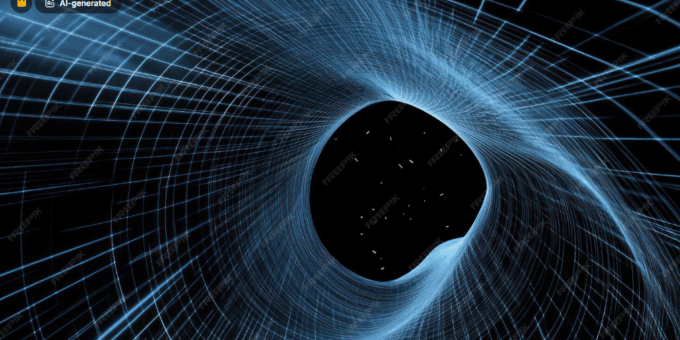
How to Understand Black Holes and Space-Time is a question that fascinates students, science lovers, and anyone curious about the universe. Black holes sound mysterious and even frightening, yet they follow clear physical laws. Space-time, while abstract, can be understood with the right explanations and examples.
This guide breaks down complex ideas into simple concepts. You will learn what black holes really are, how space-time works, and why these ideas matter in modern astronomy and physics. No advanced math is required, only curiosity.
What Is Space-Time?
To begin understanding How to Understand Black Holes and Space-Time, we must start with space-time itself.
Space-time is a combination of space and time into a single structure. Instead of thinking about space and time separately, scientists describe the universe as a four-dimensional fabric.
Why Space and Time Are Connected
Albert Einstein discovered that space and time are linked. Objects with mass can bend space-time, and this bending affects how objects move.
Imagine space-time as a stretched rubber sheet. If you place a heavy ball in the center, the sheet curves. Smaller objects roll toward it. This is how gravity works in Einstein’s theory.
Understanding Gravity Through Space-Time
In everyday life, gravity feels like a pulling force. In reality, it is the result of curved space-time.
The Earth curves space-time around it. The Moon follows that curve, which keeps it in orbit.
This concept is essential to understanding black holes.
What Is a Black Hole?
A black hole forms when a massive star collapses under its own gravity.
The result is an object so dense that its gravity bends space-time extremely. Nothing can escape once it crosses a certain boundary.
The Event Horizon
The event horizon is the point of no return. Once something crosses it, escape is impossible.
Even light cannot escape, which is why black holes appear black.
The Singularity
At the center of a black hole is the singularity. This is where mass is compressed into an incredibly small point.
Our current physics cannot fully describe what happens there.
Types of Black Holes
Understanding different types helps clarify How to Understand Black Holes and Space-Time.
Stellar Black Holes
These form from dying stars and are several times more massive than the Sun.
Supermassive Black Holes
Found at the centers of galaxies, including the Milky Way.
They can be millions or billions of times more massive than the Sun.
Intermediate and Mini Black Holes
These are still theoretical or difficult to observe.
How Do Scientists Know Black Holes Exist?
Black holes cannot be seen directly, but their effects can be observed.
Scientists detect black holes by watching how nearby stars move or how gas heats up before falling in.
The first real image of a black hole was released by the Event Horizon Telescope.
You can explore this breakthrough through
black hole imaging research.
Black Holes and Time Dilation
Time behaves differently near a black hole.
As you approach a black hole, time slows down relative to distant observers.
This effect is called time dilation.
Why Time Slows Near Strong Gravity
Strong gravity bends space-time so much that time itself stretches.
This idea is part of Einstein’s theory of general relativity.
Can Black Holes Destroy Everything?
Despite popular myths, black holes do not wander through space swallowing everything.
If the Sun were replaced by a black hole of the same mass, Earth would orbit it almost the same way.
Black holes are dangerous only at close distances.
How Black Holes Affect Galaxies
Supermassive black holes play a role in shaping galaxies.
They influence star formation and control energy flow in galactic centers.
NASA provides accessible explanations at
NASA black hole science.
Space-Time Ripples: Gravitational Waves
When massive objects like black holes collide, they create ripples in space-time.
These ripples are called gravitational waves.
They were first detected in 2015, confirming Einstein’s predictions.
You can learn more from
gravitational wave detection.
Common Misconceptions About Black Holes
Understanding How to Understand Black Holes and Space-Time also means clearing up myths.
- Black holes are not cosmic vacuum cleaners
- They do not instantly destroy nearby stars
- They are not holes in space
They are objects with mass, just extremely compact.
How Space-Time Explains Orbits and Motion
Planets follow curved paths because space-time is curved.
This idea replaces the old concept of gravity as an invisible force.
It also explains why GPS satellites must adjust for time dilation.
Learning Black Holes Without Advanced Math
You do not need complex equations to grasp the basics.
Visual models, animations, and analogies make these ideas accessible.
The European Space Agency offers beginner-friendly material at
ESA space science education.
Why Black Holes Matter Beyond Astronomy
Studying black holes helps test the limits of physics.
They push our understanding of space, time, and energy.
This kind of long-term thinking mirrors building passive income. Results come from patience, research, and steady learning.
Connecting Complex Science to Everyday Thinking
Black holes teach us that reality is often different from intuition.
In the same way, many people misunderstand affiliate vs dropshipping when starting an online business.
Once fundamentals are clear, both science and business become easier to navigate.
Black Holes in Popular Culture vs Science
Movies often exaggerate black hole effects.
While artistic, these portrayals rarely match scientific reality.
Learning the science builds a deeper appreciation.
How to Keep Learning About Black Holes
Follow space agency updates and educational platforms.
Join astronomy forums or watch lectures online.
Consistency matters, just like in affiliate marketing or building a dropshipping business.
Internal Resources to Expand Your Knowledge
Continue exploring with our in-depth guides:
Astronomy for Beginners
Guide to Deep Space Objects
Why Curiosity About Space-Time Is Important
Understanding black holes changes how we see the universe.
It reminds us that space and time are dynamic, not fixed.
This perspective encourages lifelong learning.
Final Thoughts on How to Understand Black Holes and Space-Time
How to Understand Black Holes and Space-Time does not require advanced physics or mathematics. With simple explanations, real-world comparisons, and reliable resources, anyone can grasp these concepts.
Black holes are not just cosmic mysteries. They are laboratories for understanding reality itself.
By learning how space-time bends and how black holes form, we gain insight into the deepest workings of the universe.
